Best Yarn for Crochet Coasters: Cotton, Blends and What to Skip
Cotton is the usual pick for crochet coasters, but blends, yarn weight and finish all change the result. Here is how to choose a yarn and estimate how much to buy.
Pattern at a glance
Materials
- Worsted weight (#4) cotton yarn for most coasters
- DK weight (#3) cotton yarn for thinner coasters
- Kitchen scale for estimating yarn
- White paper towel for a colorfastness test
The yarn you choose decides how a coaster behaves under a sweating glass far more than the pattern does. A plain circle in the right fiber does its job, while an elaborate one in the wrong fiber mostly just looks nice. The short version: reach for worsted weight (#4) cotton first, consider a cotton blend second, and think twice about anything else.
What a Coaster Asks of Yarn
A coaster sits between a drink and a table, so it deals with condensation, the odd drip of coffee and regular washing. That gives you a short list of things to look for:
- A fiber that takes up moisture instead of letting it bead on the surface.
- Crisp stitches that hold their shape, so the coaster lies flat and stays the size you made it.
- A smooth surface with little fuzz, so a glass stands steadily.
- Color that stays put when the coaster gets wet.
- Easy care, because coasters get washed.
Cotton: The Usual Recommendation
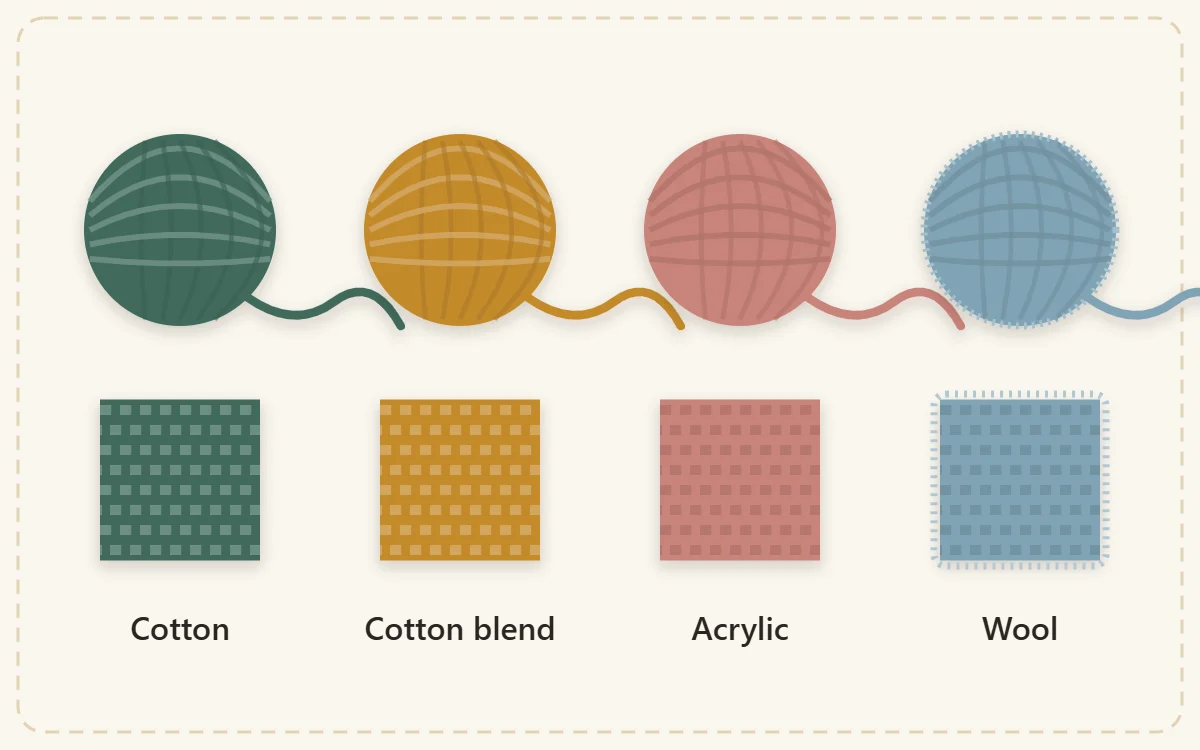
Cotton is a plant fiber that takes up moisture, which is why it is the usual recommendation for coasters, dishcloths and other table items. It also has very little stretch. That makes it slightly harder on the hands than a springy yarn, but it means stitches stay where you put them and a circle keeps its shape. Cotton generally copes well with frequent washing, though you should always follow the care instructions on the label of your own yarn.
How much moisture a finished coaster handles depends on the yarn, the stitch density and the thickness of the fabric, not on the fiber alone. A thin, open coaster in cotton may still let water through to the table. Test your own coaster with a cold glass before trusting it on a delicate surface.
Cotton Blends: A Softer Compromise
Blends mix cotton with another fiber, often acrylic, viscose or linen. They tend to be softer, lighter and easier on the hands than pure cotton, and some have more drape. The trade-off is that the more synthetic fiber is in the mix, the less the yarn behaves like cotton. Read the fiber content on the label, and treat anything that is half synthetic or more with the caution you would give acrylic.
Acrylic and Wool: What to Skip and When
Acrylic is inexpensive, comes in every color and is pleasant to work with, so it is tempting. The drawback is that acrylic and other synthetics take up very little moisture. Condensation tends to sit on the surface or run off the edge instead of soaking in. For a purely decorative coaster, or one that only ever sees a dry mug, that may not matter. For iced drinks, cotton is the safer pick.
Wool does take up moisture, but it brings other issues. It is usually fuzzier, it has a springy stretch that makes flat shapes less stable, and wool that is not labeled superwash can felt and shrink when it is washed warm with agitation. Novelty yarns such as chenille, eyelash or anything with a heavy halo are also poor choices, because a glass needs a level surface to stand on.
Yarn Weight: Worsted First, DK for Thinner Coasters
Most coaster patterns, including the ones on this site, are written for worsted weight yarn, labeled #4 or “medium” in the standard yarn weight system. Worked a little tightly, it gives a coaster with enough thickness to feel substantial, and a classic four-round circle lands at about 4 to 4.5 in (10 to 11.5 cm). DK weight (#3, “light”) makes a thinner, finer-looking coaster. The same pattern comes out smaller in DK, so expect to add a round or two. Hook choice matters as much as weight here, and the guide to choosing a hook size for coasters covers how to pair the two.
Mercerized vs. Unmercerized Cotton
Mercerized cotton has been treated to make it smoother and more lustrous. It has a slight sheen, comes in strong, clear colors and shows stitches sharply, which suits flower coasters and other detailed shapes. Unmercerized cotton is matte, softer and a little fluffier, and it is the kind most often sold for kitchen and dishcloth use. Both are cotton and both work. Choose mercerized when you want polish and definition, unmercerized when you want a soft, casual look.
Tip
Buying yarn for a matching coaster set? Buy all of it at once and check that the dye lot numbers on the labels match. Small shade differences between lots show up clearly when coasters are stacked.
Check Colorfastness Before You Commit
Deep reds, navy and other saturated shades sometimes release dye the first few times they get wet. On a coaster, that could mean color moving into a neighboring cream stripe or onto whatever is underneath. A quick test is worth the few minutes it takes:
- Crochet a small swatch that includes every color you plan to combine.
- Soak it in lukewarm water with a drop of mild soap for about 15 minutes.
- Press it between two layers of white paper towel or an old white cloth.
- Let it dry, then look for color on the towel or in the lighter stitches.
If you see transfer, pick another shade, or keep that yarn for single-color coasters and wash them separately.
How Much Yarn a Coaster Takes
Coasters are small, which makes them good for using up partial balls. As a rough estimate, one coaster of about 4 in (10 cm) in worsted cotton often uses somewhere between 12 and 25 yards (11 to 23 m), with dense or textured designs at the upper end. Your hook, gauge and pattern will move that number, so measure instead of guessing:
- Make one coaster and weigh it on a kitchen scale, in grams.
- Read the weight and length of a full ball from the label, and divide length by weight to get yards per gram.
- Multiply that figure by the weight of your coaster, then by the number of coasters you want.
- Add a margin of around 10 to 15 percent for tails and a swatch.
For example, a ball labeled 50 g and 85 yards works out to 1.7 yards per gram. A coaster that weighs 10 g used about 17 yards, so four of them would need about 68 yards, plus the margin.
A Sensible Starting Point
If you are buying one ball to learn with, make it a worsted weight cotton in a light, solid color. Light shades show your stitches clearly, which helps with counting. Pair it with a US H-8 (5 mm) hook and start with the beginner crochet coaster.
Frequently asked questions
Can I use acrylic yarn for crochet coasters?
You can, especially for decorative coasters. Acrylic takes up very little moisture, so condensation tends to sit on the surface or run off, which is why cotton is usually suggested for cold drinks.
Is DK or worsted weight yarn better for coasters?
Worsted weight (#4) is the common default because it gives a thicker coaster in few rounds. DK weight (#3) works too and gives a thinner, finer result, but you will usually need extra rounds to reach the same size.
How do I know if my yarn will bleed color?
Soak a small swatch in lukewarm water with a drop of mild soap, then press it between white paper towels. Any color on the towel or in lighter stitches means the dye is not fully fast.