What Crochet Hook Size to Use for Coasters
Coasters work best in a dense fabric, which usually means a hook one size smaller than the yarn label suggests. Here is how to choose a size and test it with a swatch.

Pattern at a glance
Materials
- Worsted weight (#4) cotton yarn, the same yarn you will use for the coasters
- Two or three hooks in neighboring sizes
- Tape measure or ruler
- Scissors
For most coasters in worsted weight (#4) cotton, a US H-8 (5 mm) hook is the place to start, and a US G-6 (4 mm) is the one to pick up when you want a firmer, denser result. That is usually one or two sizes smaller than the yarn label suggests, and the difference is deliberate.
Why Coasters Want a Dense Fabric
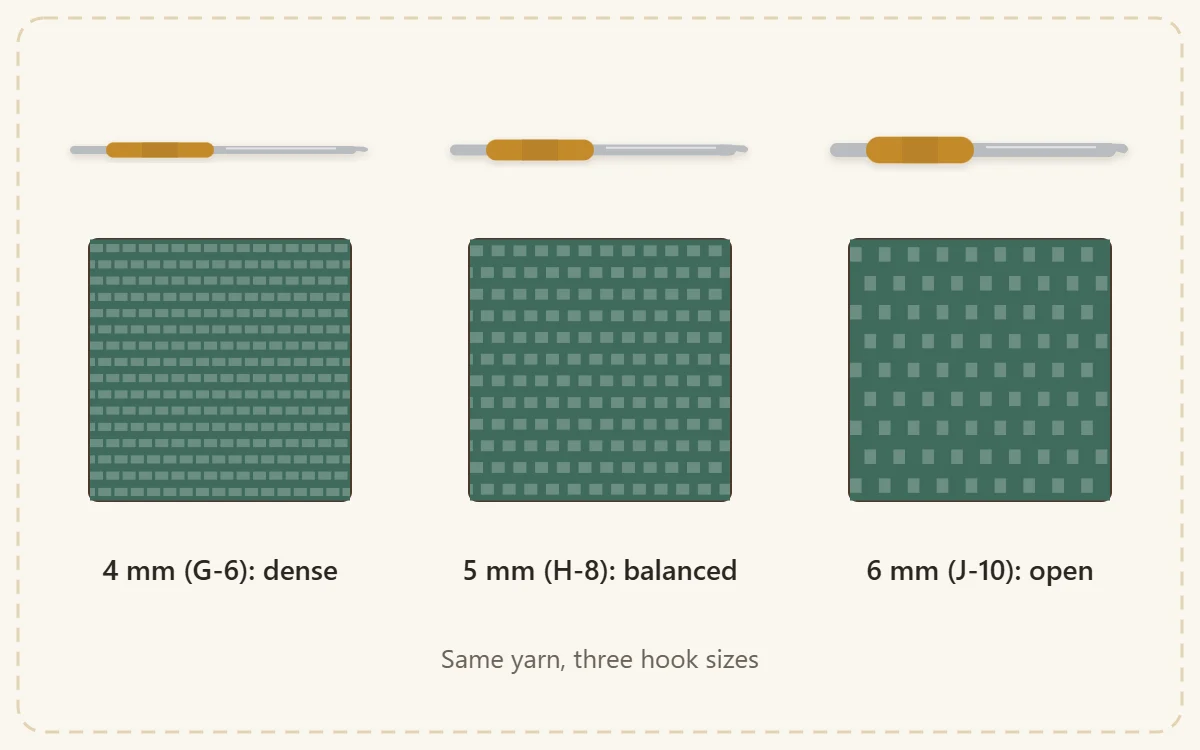
The hook size printed on a yarn label is chosen for fabric with some drape, the kind you want in a garment or a blanket. A coaster has the opposite job. It should lie flat, keep its shape when you pick it up by one edge, and have no obvious gaps for condensation to pass straight through. Tighter stitches help with all three: the fabric is stiffer, the holes between stitches close up, and there is more yarn in every square inch. A smaller hook is the simplest way to get there without changing how you hold your yarn.
Density is not a guarantee of anything. How a coaster copes with a wet glass still depends on the fiber, as covered in the guide to the best yarn for crochet coasters, and on the thickness of the finished fabric.
Start One Size Below the Label
Look at the ball band. Many worsted weight cottons suggest a US I-9 (5.5 mm) hook, and some suggest an H-8 (5 mm). Go down one size from whatever is printed and make that your first attempt. If the label says 5.5 mm, try 5 mm. If it says 5 mm, try 4.5 mm. Then let a swatch tell you whether to go down again.
For DK weight (#3) yarn, the same logic applies from a smaller starting point. Labels often suggest about 4 mm, so a US E-4 (3.5 mm) hook is a reasonable first try.
Hook Sizes at a Glance
US hooks carry a letter, a number or both. The metric size in millimeters is the measurement to trust, because it describes the actual diameter of the shaft. The standard hook size chart lists the full range. These five cover nearly every coaster made in worsted weight cotton:
| US size | Metric | What to expect in worsted weight cotton |
|---|---|---|
| G-6 | 4 mm | Dense and firm; the smallest coaster; more effort for the hands |
| 7 | 4.5 mm | Firm, and a little easier to work |
| H-8 | 5 mm | Balanced; the usual default |
| I-9 | 5.5 mm | Softer and slightly larger; useful if your stitches run tight |
| J-10 | 6 mm | Open and floppy; rarely the right choice for a coaster |
Run a Quick Swatch Test
A swatch takes a few minutes and answers the question better than any chart. Use the yarn you plan to make the coasters with.
- With your first-choice hook, chain 13. Single crochet in the second chain from the hook and in each chain across, for 12 stitches. Chain 1, turn, and repeat for about 12 rows.
- Hold the swatch up to a window. Pinpoints of light are normal. Clear holes between stitches mean the hook is too large.
- Hold the swatch by one corner. A good coaster fabric stays fairly flat. If it flops over like a washcloth, go down a size.
- Think about how it felt to make. If you had to force the hook into each stitch, or the yarn kept splitting, the hook is too small.
- Measure the width and write it down next to the hook size, so you can compare.
How Hook Size Changes Size and Stiffness
The same pattern in the same yarn gives a different coaster on a different hook. Each stitch is a little smaller on a smaller hook, and across four or five rounds those small differences add up. Moving from a 5 mm hook to a 4 mm hook can easily take a quarter inch (about 6 mm) or more off the width of a coaster, depending on your gauge. That makes the hook a handy fine-tuning tool: if a finished coaster is slightly too big for your needs, try the next size down before you rewrite the pattern. The crochet coaster size guide explains how to decide what size you are aiming for.
Stiffness moves in the same direction. A smaller hook gives a firmer coaster with sharper edges, and a larger hook gives a softer one that drapes. Changing hooks can also change the proportions of your stitches, so a circle that was flat on one hook may start to cup or ripple on another. If that happens, the fix is in the shaping, and how to keep crochet coasters flat walks through it.
Watch out
Use one hook for a whole set. Two hooks marked with the same size can differ slightly in shape from one maker to another, and switching partway through can show up as coasters that do not quite match.
Hook Material and Shape
Size matters most, but the hook itself affects how the work feels.
- Aluminum is smooth and slick, so cotton glides along it. It is a common, affordable choice.
- Bamboo and wood have more grip. That can help with a slippery mercerized cotton and may slow you down with a matte one.
- Cushioned or shaped handles are worth considering, because cotton has very little give and dense fabric asks more of your hands.
Hook heads also come in two general shapes. An inline hook has a head the same width as the shaft and a deeper throat. A tapered hook has a rounder head and a throat that narrows gradually. Neither is better. The same person can get a slightly different gauge with each, which is one more reason to swatch with the hook you will actually use.
When the Pattern and Your Hands Disagree
The hook size in a pattern is a starting point, not a rule. If you crochet tightly, your coaster may come out small and stiff on the suggested hook, and going up a size is the right call. If you crochet loosely, go down. Judge by the fabric, not by the number on the handle: closed-up stitches, a coaster that holds itself flat, and a hook that still moves comfortably through the work.
A Simple Rule to Remember
Take the hook size on the label, go down one size, make a swatch, and adjust from there. For worsted weight cotton that usually means settling somewhere between 4 mm and 5 mm. A dense pattern such as the single crochet round coaster is a good place to see the effect, since it has no tall stitches to hide a loose gauge.
Frequently asked questions
Is a 5 mm hook good for cotton coasters?
Yes, a US H-8 (5 mm) hook is a common default for worsted weight cotton coasters. If your swatch shows clear gaps or feels floppy, try 4.5 mm or 4 mm.
What happens if my hook is too small?
The fabric becomes very stiff, the hook is hard to push into stitches and the yarn may split. The coaster will also come out smaller than the pattern says.
Do I need a different hook for DK weight yarn?
Usually, yes. DK yarn labels often suggest about 4 mm, so 3.5 mm is a reasonable starting point for a dense coaster fabric, checked with a swatch.