Beginner Crochet Coaster: Your First Project Step by Step
A first crochet project in one stitch: a square coaster of 15 single crochet per row with a simple border, plus how to count stitches and keep the edges straight.
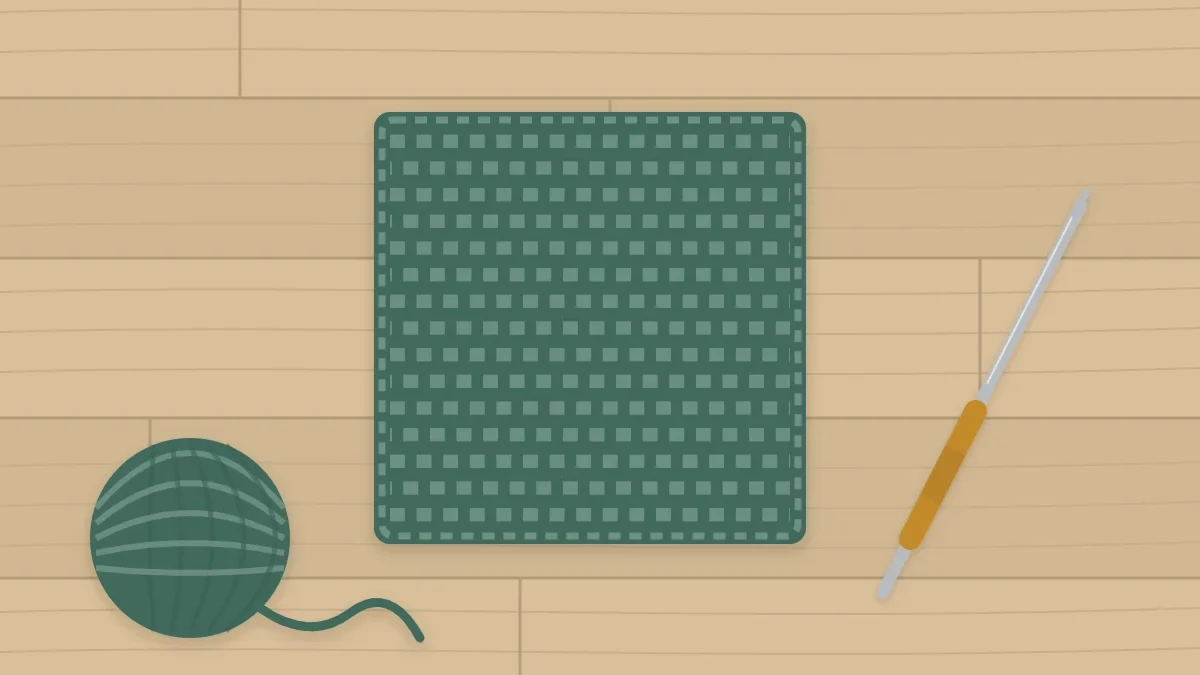
Pattern at a glance
Materials
- Worsted weight (#4) cotton yarn, one light solid color
- Yarn needle
- Scissors
- Stitch marker (optional)
A square coaster in single crochet is about the kindest first project there is. It uses one stitch, it is small enough to finish in an evening, and if a row goes wrong you only have fifteen stitches to pull out. By the end you will have practiced the things every later pattern assumes: making a chain, working into it, turning, counting and finishing an edge. The pattern uses US crochet terms.
What You Need
- Worsted weight (#4) cotton yarn in a light, solid color, which makes the stitches easy to see
- US H-8 (5 mm) crochet hook
- Yarn needle and scissors
- A stitch marker or a scrap of contrasting yarn (optional, but helpful)
A coaster uses only a small part of a ball, roughly 15 to 25 yards as an estimate; weigh your finished coaster and compare it with the yarn label to find your own figure. Cotton is the usual choice because it is a plant fiber that takes up moisture; the reasons are explained in the guide to the best yarn for coasters. The finished square should measure about 4.25 in (11 cm) on each side, but your gauge will decide the exact size.
Start With a Slip Knot and a Chain
Make a loop in the yarn about 6 in (15 cm) from the end, reach through it, pull up a strand of the yarn that leads to the ball, and tighten. That is a slip knot. Slide it onto your hook and snug it up so it moves freely without being loose.
To chain, wrap the yarn over the hook from back to front (a yarn over) and pull it through the loop on the hook. That is one chain. The loop on the hook never counts as a chain, and neither does the slip knot. Keep the chains relaxed: a tight foundation chain is hard to work into and makes the bottom edge pull in.
The Pattern
Abbreviations: ch = chain, sc = single crochet, sl st = slip stitch.
To make a single crochet, insert the hook into the stitch, yarn over and pull up a loop (two loops on the hook), then yarn over and pull through both loops.
- Foundation: Ch 16.
- Row 1: Sc in the 2nd ch from the hook and in each ch across. (15 sc)
- Row 2: Ch 1 (does not count as a stitch), turn. Sc in the first stitch and in each stitch across. (15 sc)
- Rows 3 to 16: Repeat Row 2. (15 sc in each row)

Sixteen rows is a guide, not a rule. Fold one corner over diagonally: when the top edge lines up with the side edge, the piece is square. Add or leave out a row if you need to. Do not cut the yarn yet.
Counting Your Stitches
Look down at the top edge of a row and you will see a line of sideways V shapes. Each V is the top of one stitch, and you insert the hook under both strands of it. Count the V shapes at the end of every row until the count stays at 15 without effort. It takes a few seconds and it is the habit that prevents most beginner problems.
To count rows, look at the face of the fabric. Single crochet rows form small horizontal ridges, and each ridge-and-valley pair is two rows.
Keeping the Edges Straight
Coasters that grow wider or narrower almost always go wrong in the same two places: the first stitch of the row and the last.
- The first stitch. After you chain 1 and turn, work into the very first stitch, the one at the base of the chain. The chain 1 only lifts the yarn to the height of the new row. Skip that first stitch and you lose one every row.
- The last stitch. The final stitch of a row can tilt and hide. If you only count 14, there is one more at the edge. Do not work into the turning chain from the row below, or you will gain a stitch.
Tip
Clip a stitch marker into the first stitch of each row as soon as you make it. When you come back along the next row, the marker shows you exactly where the last stitch is.

Adding the Border
A round of single crochet hides uneven row ends and frames the square. Three stitches in each corner let the border turn without pulling.
- Top edge: Ch 1, turn. 3 sc in the first stitch, sc in each of the next 13 stitches, 3 sc in the last stitch. (19 sc)
- First side: Turn the work a quarter turn. Sc in the end of each row. (16 sc)
- Bottom edge: Working into the unused loops of the foundation chain, 3 sc in the first ch, sc in each of the next 13 ch, 3 sc in the last ch. (19 sc)
- Second side: Sc in the end of each row. (16 sc)
- Join: Sl st in the first sc of the round. (70 sc in total)
If you worked more or fewer than 16 rows, the two sides will have that number of stitches instead, and both sides should match. If the border ruffles along the sides, skip one row end near the middle of each side. If it pulls in, add one.
Finishing and What to Make Next
Cut the yarn, leaving a tail of about 6 in (15 cm), and pull it through the loop on your hook. Thread each tail onto the yarn needle and weave it through the back of the stitches, changing direction a couple of times before trimming. The full method, including a neater way to close the round, is in the guide to weaving ends and clean joins.
Your first coaster will probably not be perfectly square, and that is normal. Compare it with the list of common coaster mistakes and their fixes, then make a second one: the difference is usually obvious. Because cotton and stitch density vary, test a finished coaster under a cold glass before you rely on it on a delicate surface.
When the single crochet feels automatic, the moss stitch coaster is a natural next step. It adds only a chain between stitches and gives a woven-looking texture.
Frequently asked questions
Why is my square coaster getting wider or narrower?
The stitch count is changing at the row ends. Count 15 stitches in every row, work into the first stitch after the turning chain, and do not skip the last stitch.
Does the turning chain count as a stitch in this pattern?
No. The chain 1 at the start of each row only raises the yarn to the height of the row, so you work a single crochet into the very first stitch.
Can I use acrylic yarn for a first coaster?
You can use it to practice the stitches. Cotton is the usual recommendation for a coaster you will use, because it is a plant fiber that takes up moisture and acrylic takes up very little.