How to Keep Crochet Coasters Flat: Fixing Cupping and Ruffling
Cupping means a round has too few stitches and ruffling means it has too many. Learn the circle math for each stitch height and how to diagnose and fix both problems.
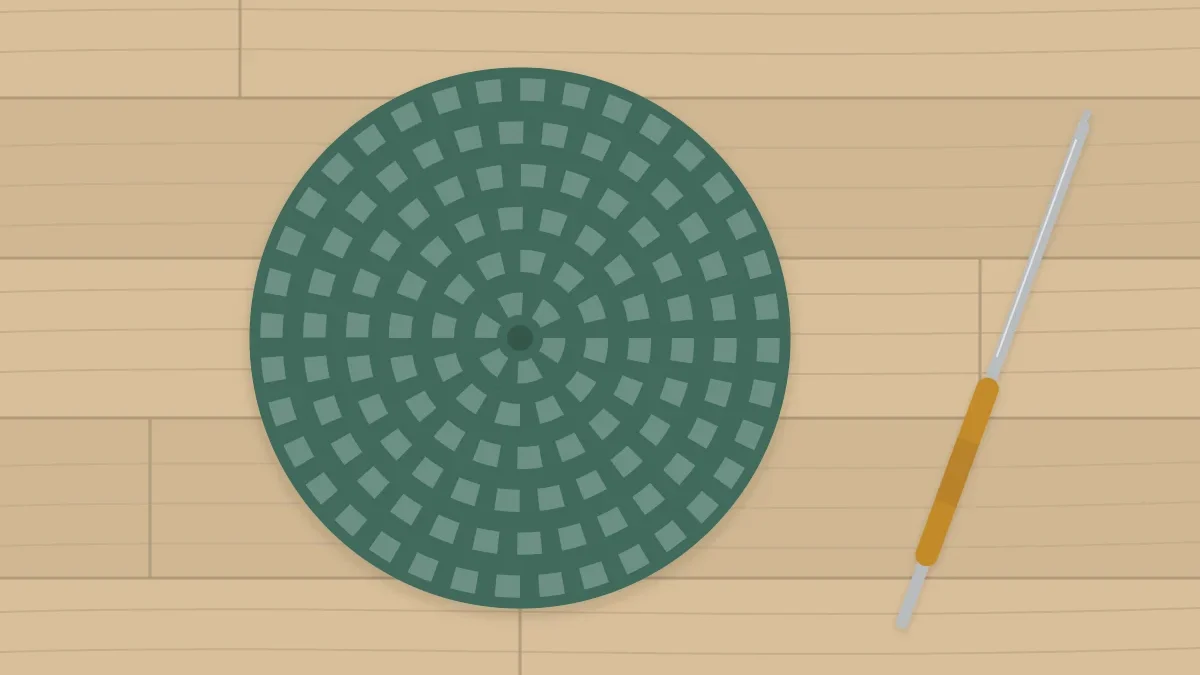
A coaster only works if a glass sits level on it, so a circle that curls into a shallow bowl or waves like a lettuce leaf is more than a cosmetic problem. Both faults come from the same place: the number of stitches in a round does not match the distance that round has to travel. Once you can read which way your coaster is going wrong, the fix is usually a few stitches or one hook size away. This guide uses US crochet terms throughout.
Why a Circle Curls or Waves
Each round of a flat circle is longer than the one before it, because it sits farther from the center. Increases supply that extra length. Add exactly enough and the fabric lies flat. Add too few and the outer edge is too short to go all the way around, so it pulls inward and the piece rises into a cup. Add too many and the edge is too long, so the surplus folds itself into waves.
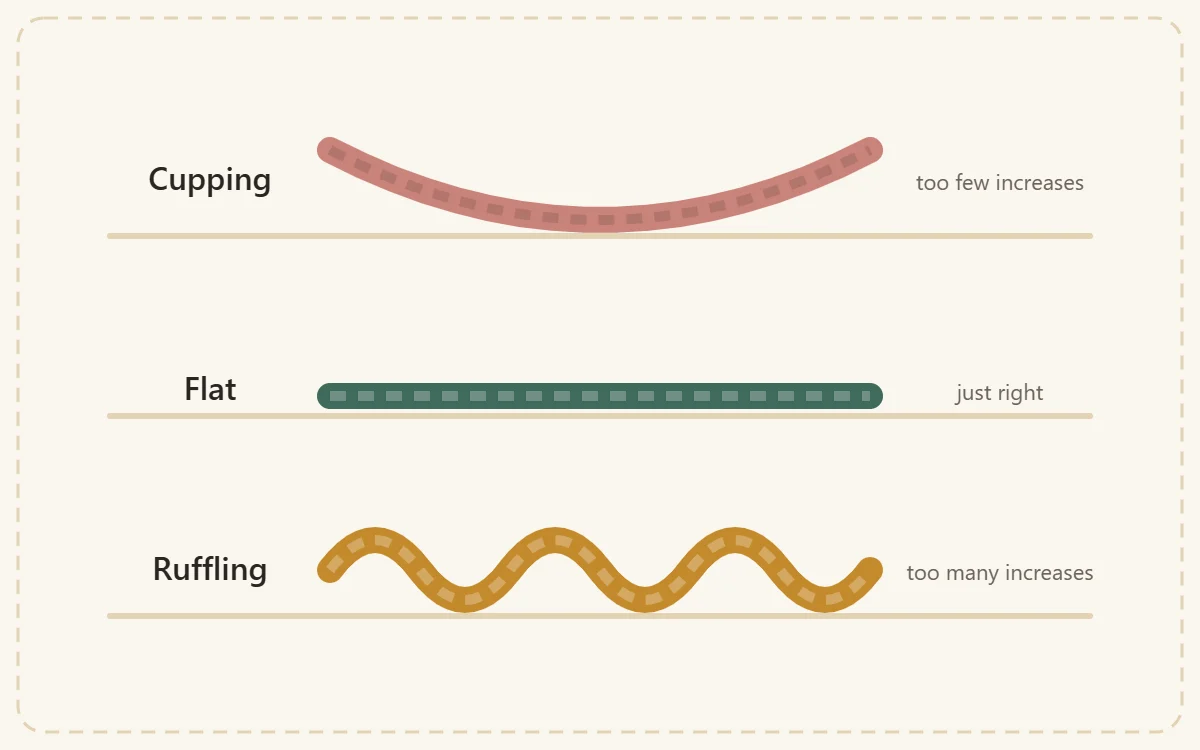
Gauge pulls the same lever from the other side. Very tight stitches are narrower, which shortens a round even when the count is right. Loose stitches are wider and lengthen it. That is why two people can follow the same correct pattern and get two different shapes.
The Circle Math by Stitch Height
Taller stitches make a wider ring, and a wider ring needs more stitches to reach around its outer edge. So the starting number changes with the stitch you use:
- Single crochet: start with 6 stitches and add 6 in every round (6, 12, 18, 24, 30).
- Half double crochet: start with 8 and add 8 in every round (8, 16, 24, 32).
- Double crochet: start with 12 and add 12 in every round (12, 24, 36, 48).
The rhythm inside the rounds is the same for all three. Round 2 increases in every stitch, round 3 in every second stitch, round 4 in every third stitch, and so on, with one more plain stitch between increases each time.
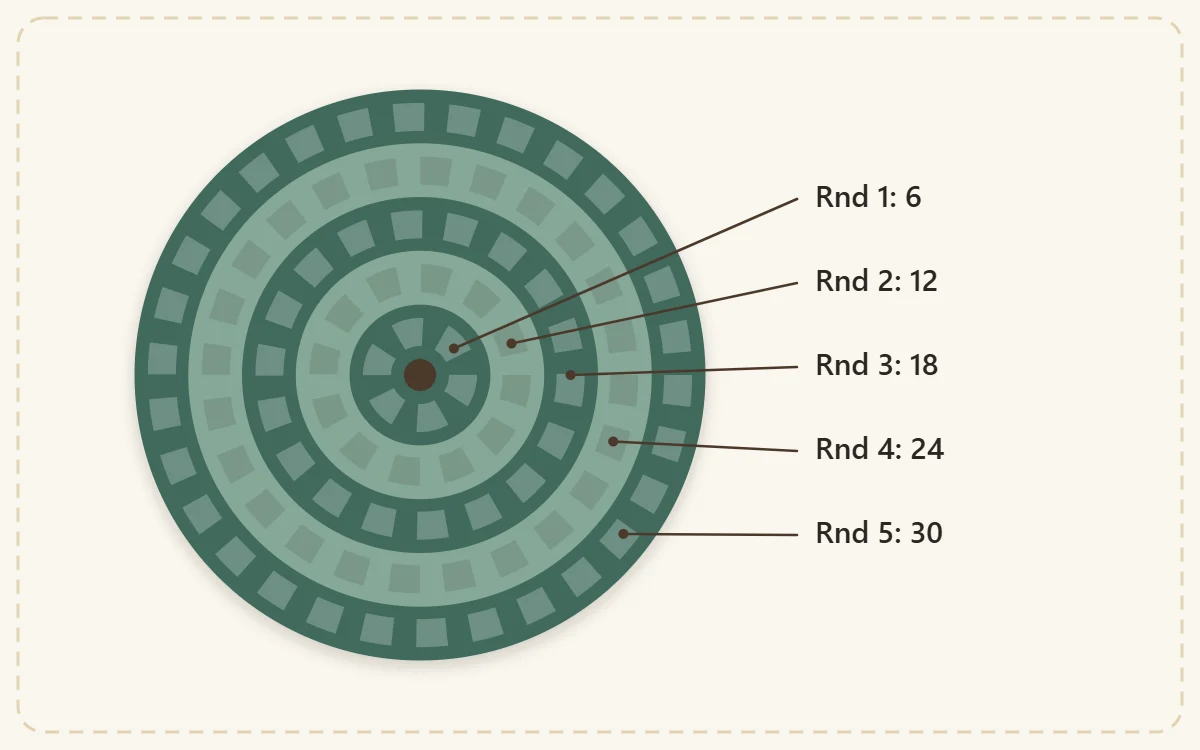
You can see both ends of that range worked out in full in the single crochet round coaster and the classic double crochet round coaster. Treat the formulas as a reliable starting point rather than a law. Your yarn, hook and hands decide whether they need a small adjustment.
Cupping: Too Few Stitches or Too Tight
If the edge lifts off the table and the coaster starts to look like a tiny bowl, the outer rounds are too short. Work through the likely causes in this order:
- A missed increase. Count the last round. A single crochet round 4 should have 24 stitches, not 22 or 23. Rip back to the round where the count went wrong.
- The wrong starting number. Starting a double crochet circle with 8 or 10 stitches instead of 12 leaves every later round short.
- Stitches that are too tight. If the counts are right and it still cups, go up one hook size, for example from US G-6 (4 mm) to US 7 (4.5 mm), or consciously relax your grip on the yarn.
There is more on matching hook to yarn in the guide to hook sizes for coasters.
Ruffling: Too Many Stitches or Too Loose
A wavy, frilled edge means the round is longer than the circle needs. The causes mirror the ones above:
- Extra increases. Repeating an increase round, or increasing in every second stitch when the round called for every third, adds length fast. Count, then rip back.
- Too many stitches in round 1. Fourteen or fifteen double crochets in the ring will ripple from the start.
- A join worked as a stitch. In joined rounds, working into the slip stitch or into the same stitch as the starting chain by mistake adds one stitch per round.
- Loose, tall stitches. If the counts are right, go down one hook size.
How to Check as You Go
Lay the work on a table after every round and let it rest without pressing it down. Flat fabric stays put. A cup rocks when you tap the edge, and a ruffle will not sit down however you arrange it. A slight wobble in the first two rounds often settles as the circle grows, but a fault that is still there after round 4 will not correct itself.
Count every round before you start the next one, and mark the first stitch of the round with a stitch marker, especially when you work in a continuous spiral. Catching a miscount one round later costs a minute. Catching it at the edge costs the coaster.
Staggering Increases to Avoid a Hexagon
When every increase sits directly on top of the increase below, the six increase points line up and push out into corners. The count is right and the coaster is flat, but it looks like a hexagon. The fix is to shift the increases on alternate rounds while keeping the same total. For a single crochet circle:
- Rnd 4, standard: (2 sc in next stitch, sc in next 2 stitches) 6 times. (24 sc)
- Rnd 4, staggered: sc in next stitch, 2 sc in next stitch, (sc in next 2 stitches, 2 sc in next stitch) 5 times, sc in next stitch. (24 sc)
- Rnd 5, standard: (2 sc in next stitch, sc in next 3 stitches) 6 times. (30 sc)
Both versions of round 4 use 18 stitches from the round below and produce 24. Only the position of the increases moves. Work even-numbered rounds staggered and odd-numbered rounds as standard and the corners disappear.
Keeping Square Coasters Flat
Squares worked in the round do all their growing at the corners. In a solid double crochet square each corner is (2 double crochet, chain 2, 2 double crochet), which adds 4 stitches to every side in every round. If the corners pull in and the square cups, your corner chains are probably tight, so work them more loosely. If the corners flare and ruffle, make sure you have not put extra stitches into the corner space.
Blocking Is the Last Step, Not the Repair
Blocking relaxes the fibers and evens out a faint curl or a slightly uneven edge, and it is worth doing on any coaster made of cotton. It cannot remove a real cup or a deep ruffle, because those are built into the stitch count. Get the math right first, then follow the steps for blocking coasters so they lie flat to finish the job.
Frequently asked questions
Why does my crochet coaster curl up at the edges?
The outer rounds are too short for the circle. Usually an increase was missed or the stitches are very tight, so count the last round and try a hook one size larger.
Why is my crochet circle wavy?
A wavy edge means the round has more stitches than it needs or the stitches are loose. Check for extra increases first, then try a hook one size smaller.
Can I fix a cupped coaster without starting over?
A faint curl often relaxes with blocking. A clear bowl shape is built into the stitch count, so the reliable fix is to rip back to the round where the count went wrong.