How to Change Colors in Crochet Coasters Without the Mess
A clean color change comes down to one rule: finish the last yarn over of the previous stitch with the new color. Here is how it works in rows, rounds and stripes.
Pattern at a glance
Materials
- Worsted weight (#4) cotton yarn in two colors
- Yarn needle
- Scissors
Nearly every messy color change comes from switching yarn one step too late. If you finish a stitch in the old color and then pick up the new one, a loop of the old color ends up sitting on top of the first stitch of your new stripe. One rule prevents it, and it applies to every stitch and every shape. Stitch names here are US crochet terms.
The One Rule: Change on the Last Yarn Over
Every crochet stitch ends with a final yarn over that is pulled through the last loops on the hook. The loop left on the hook afterward becomes the top of the next stitch. So the new color has to arrive on that final yarn over of the stitch before the change.
In single crochet, it works like this:
- Insert the hook into the stitch, yarn over with the old color and pull up a loop. You have two loops on the hook. Stop there.
- Drop the old color to the back of the work. Lay the new color over the hook, leaving a tail of about 6 in (15 cm).
- Pull the new color through both loops. The stitch is complete in the old color, and the loop on the hook is the new color.
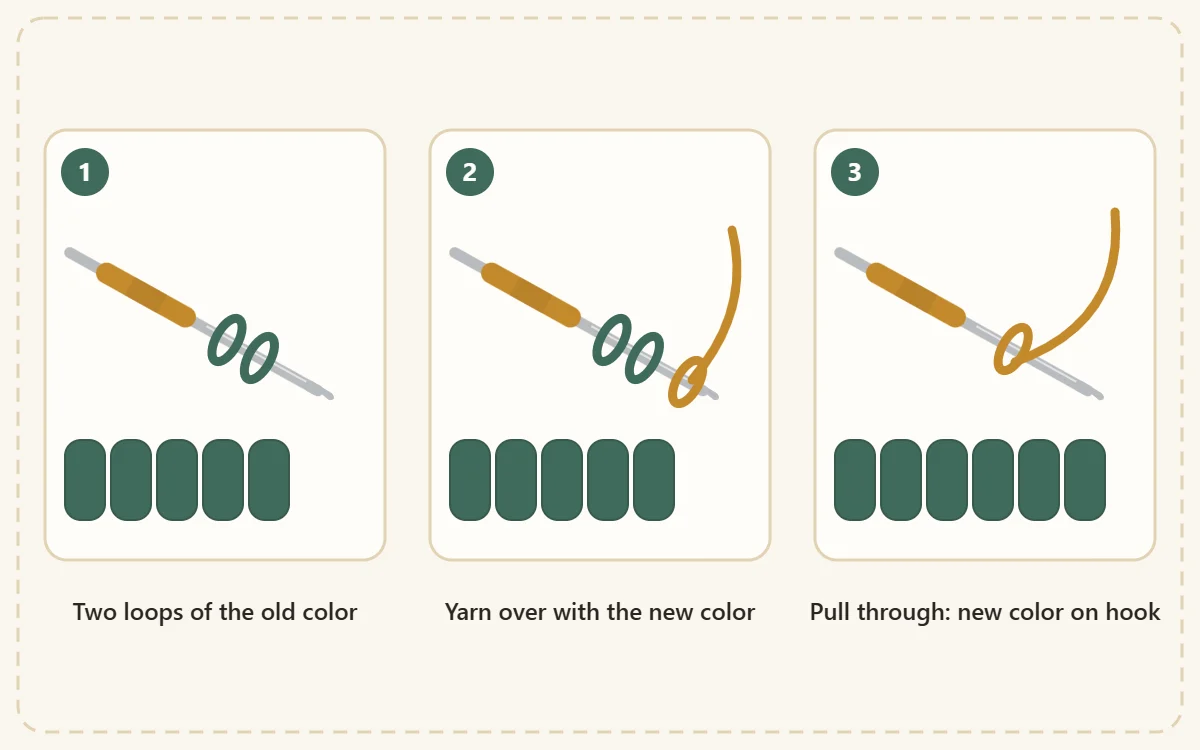
Taller stitches follow the same rule. For a half double crochet, stop when three loops remain on the hook. For a double crochet, work the first “yarn over, pull through two” as usual and stop when two loops remain. In both cases, the last pull-through is made with the new color.
Changing Colors in Rows
For stripes worked back and forth, change in the last stitch of the row. Work that stitch up to its final yarn over, finish it with the new color, then make your turning chain with the new color and turn. The turning chain belongs to the new row, so it needs to match it.
On a square worked with 15 single crochet in every row, that means the change happens in the 15th stitch. The same method gives the two-color version of the moss stitch crochet coaster its clean edges.
Changing Colors in Joined Rounds
When each round is closed with a slip stitch, the join itself is the best place to change.
- Work the last stitch of the round completely in the old color.
- Insert the hook into the first stitch of the round, as you normally would to join.
- Yarn over with the new color and pull it through the stitch and the loop on the hook. The slip stitch is made, and the loop on the hook is the new color.
- Make the starting chain of the next round in the new color and continue.
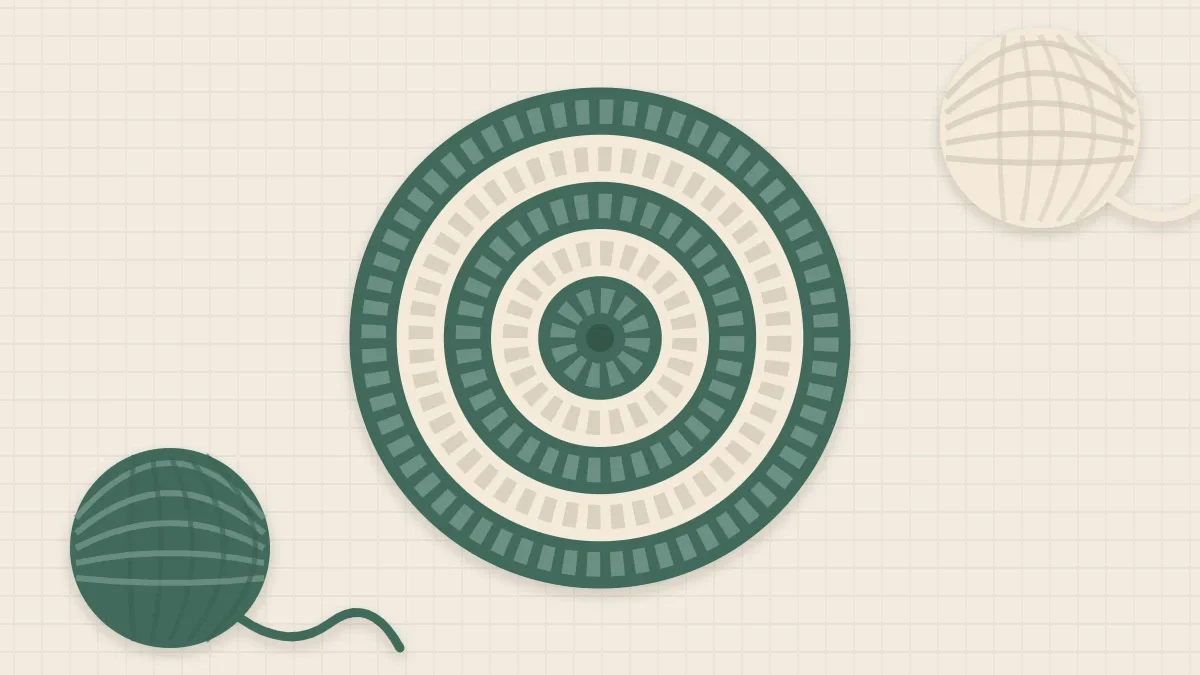
This is the method behind round designs with rings of color, such as the red, white and green rounds of the Christmas crochet coasters.
There is a second option. Fasten off the old color at the end of the round, then begin the new color with a standing stitch: put a slip knot on the hook and work the first stitch directly into the round, with no joining slip stitch or starting chain. It costs you two extra tails per round.
Stripes: Carry the Yarn or Cut It
When a color will be needed again soon, you can leave it attached and carry it up to where it is next used, instead of cutting it every time.
- In rows, carrying works when stripes are an even number of rows tall. After two rows, the yarn you dropped is waiting at the same edge. Pick it up, let the strand run loosely up the side, and hide it later under a border. With one-row stripes, the yarn is left at the opposite edge, so cut it.
- In rounds, every round begins and ends in the same place, so a dropped color is always at hand. Carry it up the back for stripes one or two rounds tall.
Keep a carried strand relaxed. Pulled tight, it puckers the fabric; left too slack, it forms a loop that can catch. For stripes taller than two rows or rounds, cutting is usually neater.
Reducing the Jog in Rounds
Each round sits one step higher than the one before it, so a stripe does not quite meet itself where the round closes. That step is called the jog. You can reduce it, though seldom erase it entirely.
- Join your rounds. Rounds closed with a slip stitch show a smaller step than a continuous spiral, especially when the color changes in the join as described above.
- Soften a spiral. In a continuous spiral of single crochet, change color on the last yarn over, then work the first stitch of the new color as a slip stitch instead of a single crochet. On the following round, work a single crochet into that slip stitch as normal. The stitch count is unchanged, because the slip stitch takes the place of one stitch. Choose a plain stitch for this, not an increase.
- Fasten off every round. Ending each color with an invisible join and starting the next with a standing stitch removes the step altogether, at the price of more tails.
Tip
When you start each round with a standing stitch, begin in a different place every time. Spreading the starting points around the circle keeps them from lining up into a visible seam.
Dealing With the Ends
Every color change you cut creates two tails. Leave each one about 6 in (15 cm) long, so there is enough to thread onto a needle.
You can save time by working over a tail as you go. Lay it along the top of the stitches you are about to work into and crochet the next six to eight stitches around it. For a coaster that will be washed often, weave the last part back in the opposite direction with a needle for extra security.
Always hide a tail in stitches of its own color, so it cannot show through. The guide to finishing crochet coasters shows how to weave ends so they stay put.
Planning Colors So Changes Stay Easy
A little planning cuts down on fiddly work.
- Change at the end of a row or round whenever the design allows.
- Limit a small coaster to two or three colors, so there are not more tails than the stitches can hide.
- Remember that strong contrast shows the jog more clearly.
- Before combining a dark color with a pale one, test for dye transfer. The method is in the guide to the best yarn for crochet coasters.
Frequently asked questions
When exactly do I switch to the new color?
Switch on the final yarn over of the last stitch in the old color. The loop that ends up on the hook forms the top of the next stitch, so it needs to be the new color.
Should I cut the yarn at every color change?
Not always. For stripes one or two rounds tall, or two rows tall, you can carry the unused color loosely up the work. For taller stripes, cutting is usually neater.
Can I get rid of the jog in striped rounds completely?
Only by fastening off each round and starting the next color with a standing stitch. Other methods, such as changing color in the joining slip stitch, make the step smaller but still visible up close.