Solid Granny Square Coaster (No Gaps)
A closed-fabric granny square coaster in four rounds of double crochet, with side counts of 3, 7, 11 and 15, advice on the twist and a single crochet border.
Pattern at a glance
Materials
- Worsted weight (#4) cotton yarn, main color
- A second color for the border (optional)
- Yarn needle
- Scissors
A solid granny square keeps the corner-out construction of the classic version but fills in the sides, so there are no gaps between clusters for a glass to sit over. You work one double crochet into every double crochet of the round below and put all the increases into the four corner spaces. The result is a closed, even fabric that suits a coaster well.
The stitch counts follow a simple pattern: every side gains four stitches per round, so the sides measure 3, 7, 11 and 15 double crochets across four rounds. This pattern is written in US crochet terms.
What You Need
- Worsted weight (#4) cotton yarn in a main color, plus a second color for the border if you like
- US H-8 (5 mm) crochet hook, or US G-6 (4 mm) for a denser fabric
- Yarn needle and scissors
Four rounds plus the border come out at roughly 4.5 in (11.5 cm) across. That figure is approximate because gauge varies; measure your own square after round 3 and decide whether you need the fourth.
Abbreviations and Notes
- ch — chain
- sl st — slip stitch
- sc — single crochet
- dc — double crochet
- st(s) — stitch(es)
- sp — space
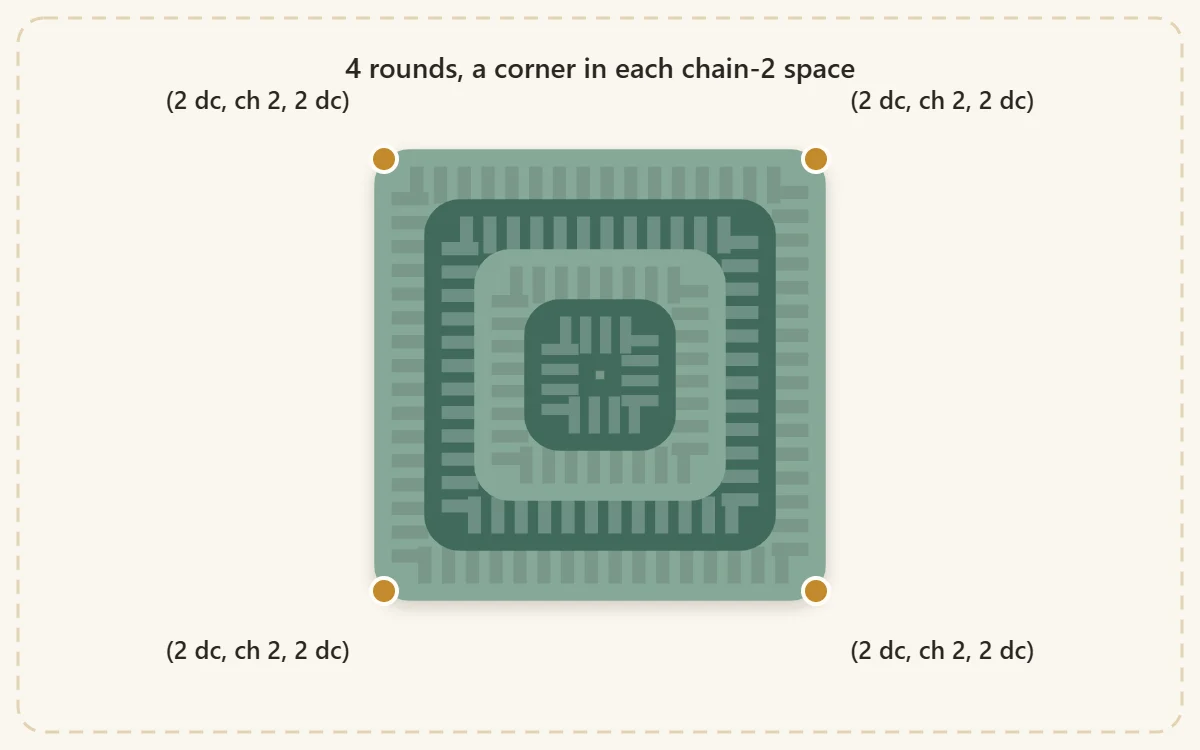
- corner — (2 dc, ch 2, 2 dc) worked into the same ch-2 space
Work in joined rounds without turning. The chain 3 at the start of every round counts as a double crochet, and each round ends with a slip stitch into the top of that chain 3. Corner chains are not included in the stitch counts.
Round 1: The Center
- Rnd 1: Make a magic ring. Ch 3 (counts as dc), 2 dc in the ring, ch 2, *3 dc in the ring, ch 2; repeat from * 2 more times. Pull the tail to close the ring and sl st to the top of the ch 3. (12 dc: 3 per side, 4 ch-2 sps)
Rounds 2 to 4: Building the Square
The round begins partway along a side, not in a corner, so the number of plain stitches before the first corner grows by two each round, and so does the number after the last corner.
- Rnd 2: Ch 3 (counts as dc), dc in each of the next 2 dc, *(2 dc, ch 2, 2 dc) in the ch-2 sp, dc in each of the next 3 dc; repeat from * 2 more times, (2 dc, ch 2, 2 dc) in the last ch-2 sp, sl st to the top of the ch 3. (28 dc: 7 per side)
- Rnd 3: Ch 3 (counts as dc), dc in each of the next 4 dc, *(2 dc, ch 2, 2 dc) in the ch-2 sp, dc in each of the next 7 dc; repeat from * 2 more times, (2 dc, ch 2, 2 dc) in the last ch-2 sp, dc in each of the last 2 dc, sl st to the top of the ch 3. (44 dc: 11 per side)
- Rnd 4: Ch 3 (counts as dc), dc in each of the next 6 dc, *(2 dc, ch 2, 2 dc) in the ch-2 sp, dc in each of the next 11 dc; repeat from * 2 more times, (2 dc, ch 2, 2 dc) in the last ch-2 sp, dc in each of the last 4 dc, sl st to the top of the ch 3. (60 dc: 15 per side)
Counting the Sides
Count a side from one chain-2 corner space to the next. Each corner contributes two double crochets to the side on its left and two to the side on its right, which is where the gain of four per side comes from.
| Round | dc per side | Total dc |
|---|---|---|
| 1 | 3 | 12 |
| 2 | 7 | 28 |
| 3 | 11 | 44 |
| 4 | 15 | 60 |
Watch out
The first double crochet after each corner space is easy to miss, because the corner stitches lean over it and hide it. If a side comes up one stitch short, that hidden stitch is the usual reason.
To make a larger piece, keep going in the same way: round 5 has 19 double crochets per side and 76 in total. If you want a larger rectangle with room for a snack instead, the easy crochet mug rug is worked in rows.
Fixing the Twist
Solid granny squares have a known habit: after a few rounds the corners seem to rotate, and the square looks as if it is turning slightly. Each double crochet sits a little to one side of the stitch beneath it, and when every round is worked in the same direction those small offsets add up.
For a four-round coaster the effect is usually mild, and there are three ways to deal with it:
- Block it square. Pin the four corners to a true square, dampen and let it dry. On a piece this small that is often enough. The method is in the guide to blocking crochet coasters.
- Turn after every round. Join, chain 3, turn the work over and crochet the next round in the opposite direction, so the lean of one round cancels the lean of the next. The totals per side stay the same, but the number of stitches before the first corner changes, so count each side to 7, 11 and 15 instead of relying on the numbers in the steps.
- Loosen the corners. If the chain 2 is tight, the corners pull inward and exaggerate the twist. Make those two chains at a relaxed size.
Single Crochet Border
A border in a second color, such as cream around a sage square, outlines the shape and hides the round joins.
- Rnd 5: Join yarn in any ch-2 corner sp. Ch 1 (does not count as a st), *3 sc in the corner sp, sc in each of the next 15 dc; repeat from * 3 more times, sl st to the first sc. (72 sc)
That is 60 single crochets along the sides and 12 in the corners. The three stitches in each corner let the border turn without pulling. For other options, including a crab stitch or picot finish, see the guide to crochet coaster edging.
Finishing
Fasten off and weave each tail through the back of the stitches in more than one direction before trimming.
Although the fabric has no gaps, how a coaster handles condensation still depends on the yarn, the stitch density and the thickness. Cotton is the usual choice because it is a plant fiber that takes up moisture. Test a finished coaster under a cold glass before trusting it on a delicate surface, and follow the yarn label when you wash it.
If you would rather have the open, lacy version of this square, the classic granny square coaster uses the same corners with clusters and chain spaces along the sides.
Frequently asked questions
How many stitches are in each round of a solid granny square?
With (2 dc, ch 2, 2 dc) corners, the rounds have 12, 28, 44 and 60 double crochets. Each side gains four stitches per round: 3, 7, 11, then 15.
Why does my solid granny square look twisted?
Double crochet stitches lean slightly, and working every round in the same direction adds the lean up. Blocking the square or turning the work after each round reduces it.
Why am I one stitch short on a side?
The first double crochet after a corner space is partly hidden by the corner stitches. Look for it right beside the chain-2 space and work into it.