Single Crochet Round Coaster: A Dense, Flat Circle
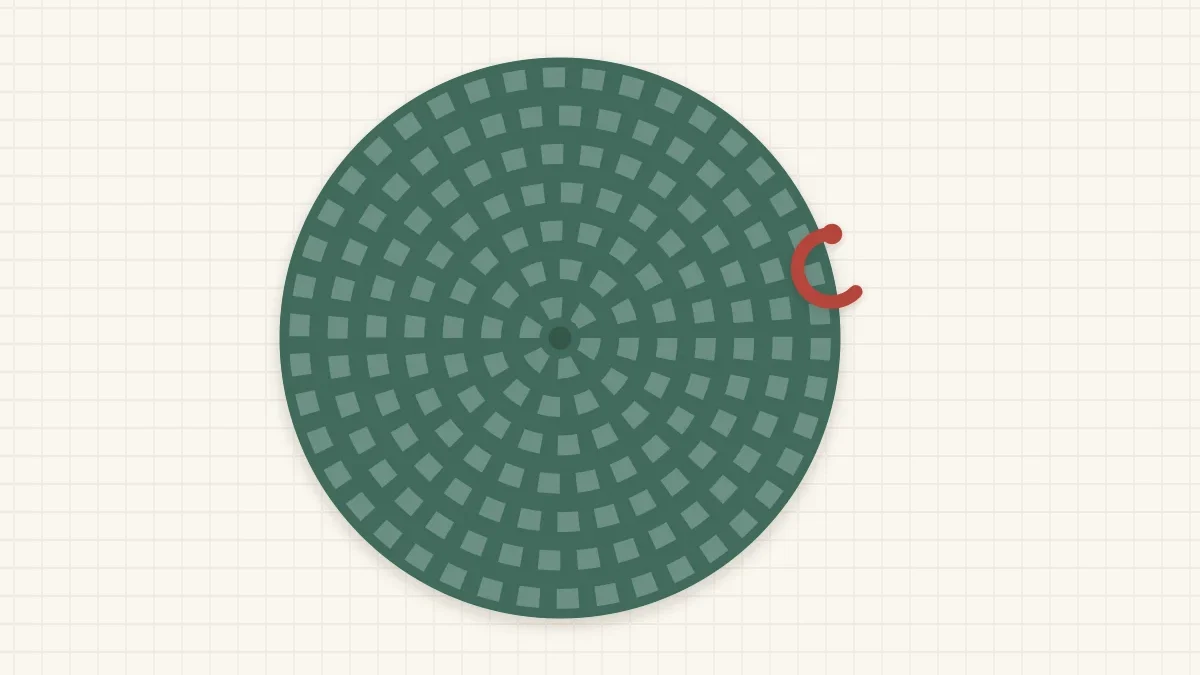
A firm round coaster worked in a continuous spiral of single crochet, from 6 to 42 stitches in seven rounds, with staggered increases to keep the edge round.
Pattern at a glance
Materials
- Worsted weight (#4) cotton yarn, one color
- Removable stitch marker
- Yarn needle
- Scissors
Single crochet is the shortest of the basic stitches, so a circle made from it is tightly packed, with small stitches and very little space between them. The result is a firm, even disc with no gaps and no seam, because it is worked in one continuous spiral.
This pattern uses US crochet terms. The only stitches are single crochet and one slip stitch at the end.
Materials and Finished Size
- Worsted weight (#4) cotton yarn, one color
- US H-8 (5 mm) hook, or US G-6 (4 mm) for an even denser fabric
- One removable stitch marker
- Yarn needle and scissors
Seven rounds give a coaster of about 3.75 to 4 in (9.5 to 10 cm) across with the larger hook. This is an estimate, since gauge varies, and the smaller hook will produce a smaller circle. Measure yours after round 7 and work the optional eighth round if you need more room. The crochet coaster size guide can help you decide what your mugs and glasses need.
Working in a Spiral With a Stitch Marker
There is no join and no chain at the end of a round here. You finish the last stitch of one round and go straight into the first stitch of the next. That avoids a seam line, but it also means nothing in the fabric tells you where a round began.
The stitch marker does that job. After you make the first stitch of a round, clip the marker into it. When you come back around and reach the marked stitch, the round is complete: take the marker out, work the first stitch of the new round into that stitch and put the marker into the stitch you have just made.
Abbreviations
- ch = chain
- sc = single crochet
- sl st = slip stitch
- st(s) = stitch(es)
Single Crochet Coaster Pattern
Do not join at the end of any round, and do not turn. Move the marker to the first stitch of each round.
- Round 1: Make a magic ring. Ch 1 (does not count as a stitch), 6 sc in the ring. Pull the tail to close the ring. (6 sc)
- Round 2: 2 sc in each st around. (12 sc)
- Round 3: (2 sc in next st, sc in next st) 6 times. (18 sc)
- Round 4: Sc in next st, 2 sc in next st. (Sc in next 2 sts, 2 sc in next st) 5 times. Sc in next st. (24 sc)
- Round 5: (2 sc in next st, sc in next 3 sts) 6 times. (30 sc)
- Round 6: Sc in next 2 sts, 2 sc in next st. (Sc in next 4 sts, 2 sc in next st) 5 times. Sc in next 2 sts. (36 sc)
- Round 7: (2 sc in next st, sc in next 5 sts) 6 times. (42 sc)
- Round 8 (optional, for a larger coaster): Sc in next 3 sts, 2 sc in next st. (Sc in next 6 sts, 2 sc in next st) 5 times. Sc in next 3 sts. (48 sc)
- Finish: Sl st in next st. Fasten off, leaving a tail of about 6 in (15 cm).
Why the Even Rounds Are Written Differently
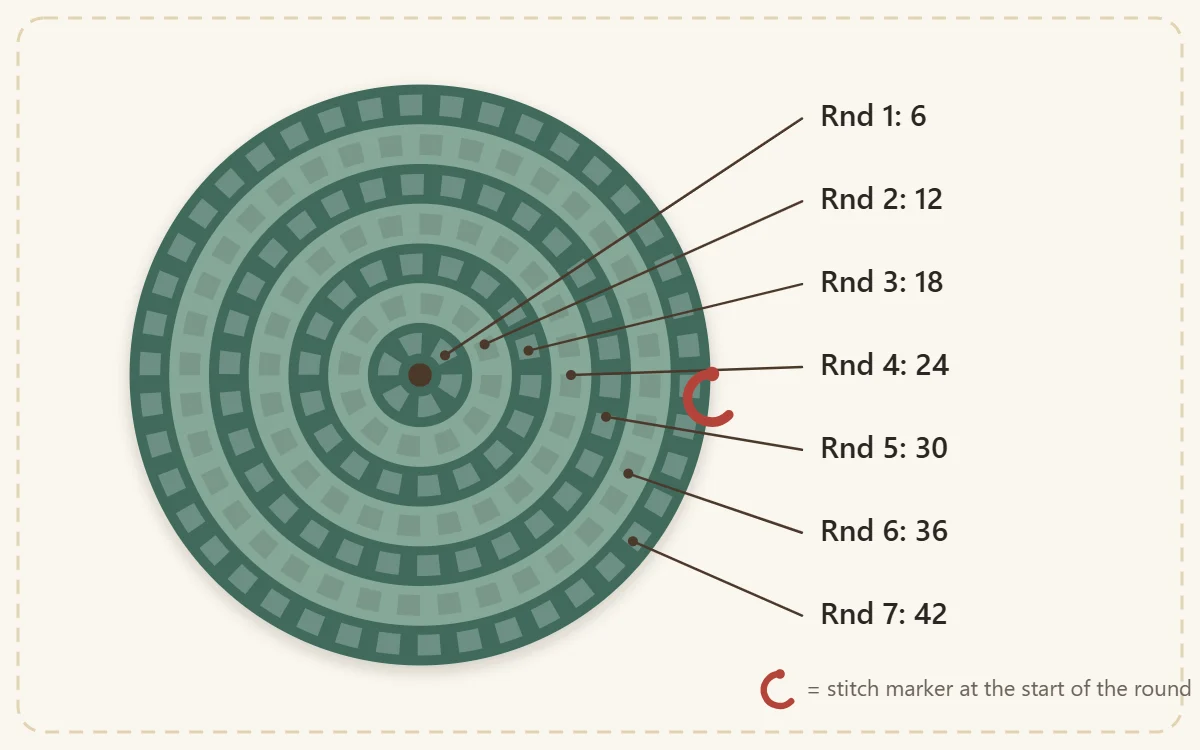
A flat single crochet circle gains six stitches per round, and every round in this pattern does exactly that. The odd rounds put each increase at the start of its repeat. The even rounds put it in the middle.
The reason is shape. If every increase sits directly above the one below, the six increase points pile up into six lines, and the circle slowly turns into a hexagon with visible corners. Moving the increases half a repeat sideways on alternate rounds spreads them out, so the edge stays round.
The even rounds do this by splitting the plain stitches of one repeat in two. Round 4 has 2 plain stitches per repeat, so it starts with 1 and ends with 1. Round 6 has 4, so it starts and ends with 2. Round 8 has 6, so it starts and ends with 3.
Tip
Count the stitches from marker to marker at the end of every round. With only six increases to place, a single missed one is enough to make the circle start to cup.
Getting a Dense Fabric
How dense the coaster feels depends on the hook as much as the stitch. The same yarn worked with a US G-6 (4 mm) hook makes smaller, tighter stitches than with a US H-8 (5 mm), giving a stiffer and slightly smaller coaster. If the fabric becomes hard to work into, or the circle begins to curl into a bowl, the hook is probably too small for the yarn or your grip.
A dense cotton fabric is the usual recommendation for coasters because cotton is a plant fiber that takes up moisture, while synthetic yarns take up very little. How well any one coaster copes with a wet glass still depends on the yarn, the stitch density and the thickness, so try yours out before trusting it on a delicate surface.
Finishing With an Invisible Join
A spiral ends one stitch higher than it began, which leaves a small step at the edge. The slip stitch in the finishing step lowers it. An invisible join then hides the end completely.
- After the slip stitch, cut the yarn and pull the tail up through the loop on the hook.
- Thread the tail onto a yarn needle. Skip the next stitch and pass the needle under both top loops of the stitch after it, from front to back.
- Bring the needle back down through the center of the slip stitch, where the tail came out, catching the back loop.
- Pull gently until the new loop is the same size as the stitches beside it, then weave in the tail on the back.
The loop you have made sits over the skipped stitch and imitates the top of a stitch, so the edge looks continuous. There is an illustrated walk-through of this join in finishing crochet coasters.
If the Circle Cups or Ruffles
Check the count before anything else: each round should have exactly six more stitches than the one before. If the counts are right and the coaster still curls upward, go up a hook size or relax your grip. If it waves at the edge, go down a size. The full troubleshooting steps are in how to keep crochet coasters flat.
When you want more surface interest than plain single crochet gives, the textured coaster with raised post stitches builds ridges onto a flat circle.
Frequently asked questions
How many stitches does a single crochet circle add each round?
Six. This coaster goes 6, 12, 18, 24, 30, 36 and 42 over seven rounds, and an eighth round would have 48.
Why does my single crochet circle look like a hexagon?
The increases are stacked directly above each other, which builds six corners. Shifting the increases to the middle of the repeat on alternate rounds keeps the outline round.
Where does the stitch marker go when working in a spiral?
In the first stitch of the round. When you reach it again, remove it, work the first stitch of the new round and clip the marker into that new stitch.

