Daisy Crochet Coaster Pattern with Loop Petals
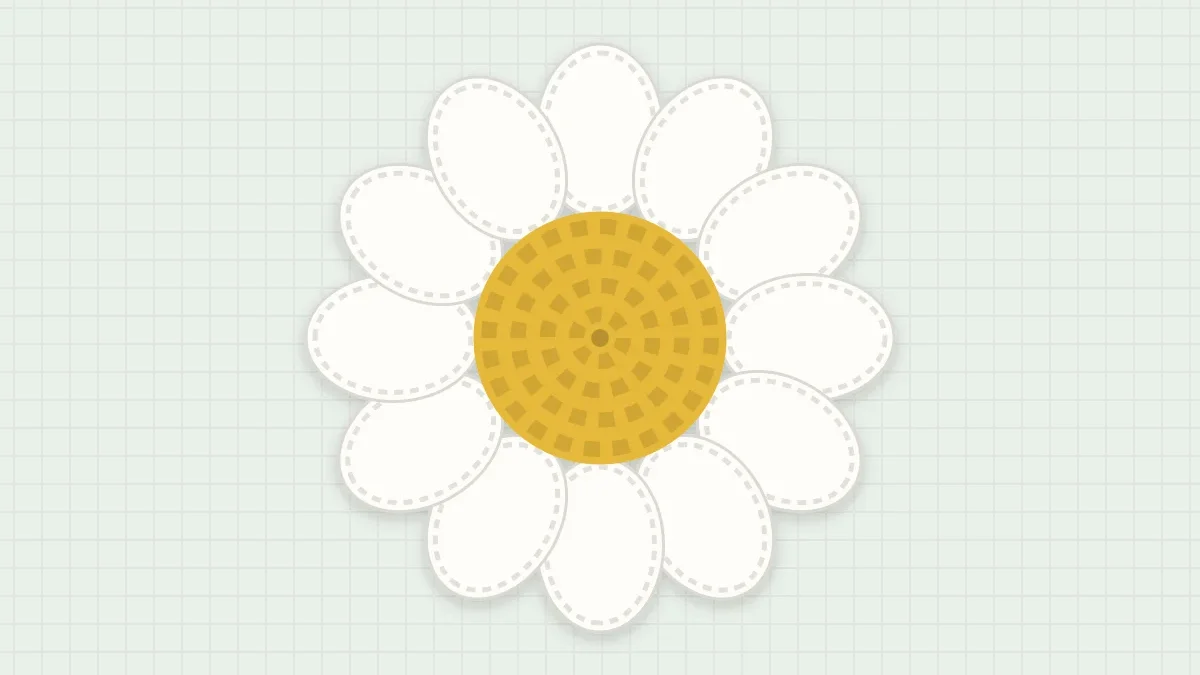
A yellow single crochet center of 24 stitches with twelve white petals, each worked over two stitches, plus an optional green backing circle for a sturdier coaster.
Pattern at a glance
Materials
- Worsted weight (#4) cotton yarn in yellow and white
- Green worsted weight (#4) cotton yarn for the optional backing
- Stitch marker
- Yarn needle
- Scissors
A daisy needs a small, tight center and a ring of narrow petals, and both come from very simple math. The yellow center is a single crochet circle worked to 24 stitches. The white petals each take two of those stitches, so 24 stitches give exactly twelve petals. Each petal rises on a chain, loops over the top in treble crochet and comes back down on a second chain, which gives it a rounded, open outline.
This pattern is written in US crochet terms.
What You Need
- Worsted weight (#4) cotton yarn in yellow (A) and white (B), plus green (C) if you make the backing
- US H-8 (5 mm) crochet hook, or US G-6 (4 mm) for a firmer center
- Stitch marker
- Yarn needle and scissors
The daisy comes out at about 4.25 in (11 cm) across the petals, with a center of roughly 2.25 in (6 cm). These are estimates; your gauge and yarn will shift them. If you want to compare fibers before you start, see the guide to the best yarn for crochet coasters.
Abbreviations and Notes
- ch — chain
- sl st — slip stitch
- sc — single crochet
- tr — treble crochet (yarn over twice before inserting the hook)
- st(s) — stitch(es)
- petal — (sl st, ch 3, 2 tr) in one st, then (2 tr, ch 3, sl st) in the next st
The center is worked in a continuous spiral: do not join at the end of a round. Place the stitch marker in the first stitch of each round and move it up as you go, because the round boundary is invisible in a spiral.
Crochet the Yellow Center
- Rnd 1: With A, make a magic ring and work 6 sc into it. Pull the tail to close the ring. (6 sc)
- Rnd 2: 2 sc in each st around. (12 sc)
- Rnd 3: *2 sc in the next st, sc in the next st; repeat from * 5 more times. (18 sc)
- Rnd 4: *2 sc in the next st, sc in each of the next 2 sts; repeat from * 5 more times. (24 sc)
Sl st in the next stitch to step the spiral down, then fasten off. That slip stitch is not counted; the edge still has 24 stitches to work into. These are the first four rounds of the single crochet round coaster, so if the circle cups or ripples, the same fixes apply.
How Twelve Petals Use 24 Stitches
Every petal occupies a pair of neighboring stitches. The first stitch of the pair holds the upward half of the petal and the second holds the downward half:
| Stitch of the pair | Work into it |
|---|---|
| First | sl st, ch 3, 2 tr |
| Second | 2 tr, ch 3, sl st |
One petal therefore contains four treble crochets framed by two chains of three. Twelve petals at two stitches each use 24 stitches, the whole of round 4, and the round contains 48 treble crochets in total.

Work the Petal Round
- Rnd 5: Join B with a sl st in any st of round 4; this is the first sl st of the first petal. Ch 3, 2 tr in the same st, (2 tr, ch 3, sl st) in the next st (first petal made). *(Sl st, ch 3, 2 tr) in the next st, (2 tr, ch 3, sl st) in the next st; repeat from * 10 more times. (12 petals, 48 tr)
The last slip stitch lands in the stitch next to the one where you joined, so no further join is needed. Fasten off.
Tip
After the sixth petal, check that you have used exactly 12 stitches and that 12 remain.
The chain 3 is slightly shorter than a treble crochet. That is intentional: it draws the sides of each petal in and curves the top. If your petals pucker, try a chain 4 at both ends instead, and use the same number on every petal.
Optional Green Backing Circle
The petals are joined only at their bases, so there is open space between them, and on its own the daisy is fairly soft at the edge. A plain backing circle sewn behind it gives a glass a continuous surface to sit on and makes the coaster sturdier. Work it in the same spiral as the center and simply keep going:
- Rnds 1–4: With C, work rounds 1 to 4 of the center. (24 sc)
- Rnd 5: *2 sc in the next st, sc in each of the next 3 sts; repeat from * 5 more times. (30 sc)
- Rnd 6: *2 sc in the next st, sc in each of the next 4 sts; repeat from * 5 more times. (36 sc)
- Rnd 7: *2 sc in the next st, sc in each of the next 5 sts; repeat from * 5 more times. (42 sc)
Lay the backing under the daisy before you fasten off. It should reach about as far as the petal tips or stop just inside them. If it is too small, add a round of (2 sc in the next st, sc in each of the next 6 sts) six times for 48 stitches; if it already shows beyond the petals after round 6, stop there. Finish with a slip stitch and leave a tail of about 24 in (60 cm) for sewing.
Watch out
Two layers make a thicker coaster, but thickness alone does not tell you how it will handle condensation. Test the finished piece under a cold glass before using it on a delicate surface.
Assembly and Finishing
Weave in the yellow and white tails first, keeping each inside its own color; the steps are in the guide to weaving in ends and clean joins. Then attach the backing:
- Center the daisy on the backing with both right sides facing up.
- Thread the green tail and stitch through the back of each petal near its tip, catching only the back strands of the white stitches so the green does not show on the front.
- Work a second ring of small stitches around the outer round of the yellow center to keep the middle from lifting.
- Secure the tail between the two layers and trim it.
Dampen the coaster, press the petals flat and evenly spaced, and leave it to dry. Follow the yarn label for washing. Bright yellow and green can sometimes release dye onto white, so wash-test a scrap of each color before the finished coaster goes in with anything else.
Frequently asked questions
How many petals does the daisy coaster have?
Twelve. Each petal is worked over two stitches of the 24-stitch center, so the petals use every stitch of the last yellow round.
Do I need the green backing circle?
No, it is optional. It closes the spaces between the petals and makes the coaster sturdier, which is useful if you plan to use it under a glass.
Why do my daisy petals curl?
Tall stitches packed into two base stitches tend to curl at first. Dampen the coaster and press or pin the petals flat while it dries.