Hexagon Crochet Coaster Pattern (Easy to Join)
A three-round hexagon coaster in double crochet with corners placed so every side stays even. Includes a single crochet border and how to join seven hexagons into a mat.
Pattern at a glance
Materials
- Worsted weight (#4) cotton yarn in a main color
- A second color for the border (optional)
- Yarn needle
- Scissors
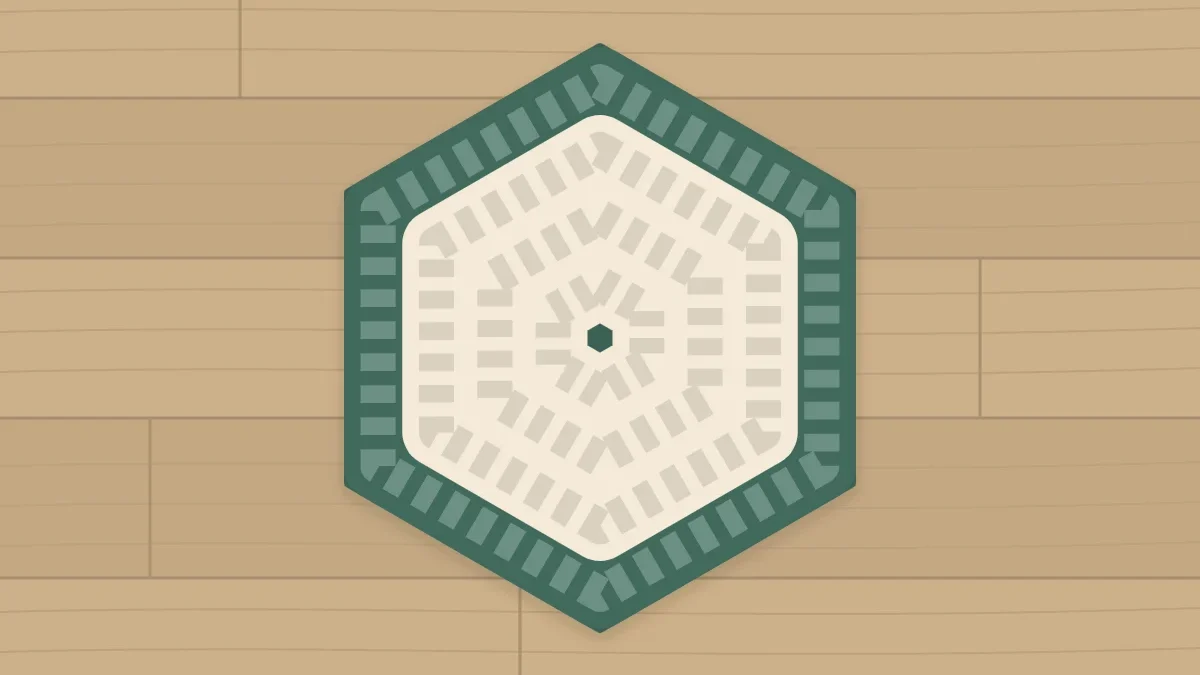
A hexagon starts life as a circle. Twelve double crochets go into a ring, and in the next round six of those stitches become corners while the six between them are skipped. That one move gives you six straight, equal edges, which is what makes hexagons so easy to sew together later.
This pattern has three rounds plus an optional border and is written in US crochet terms.
Materials and Size
- Worsted weight (#4) cotton yarn in a main color, plus a second color if you want a contrast border
- US H-8 (5 mm) hook
- Yarn needle and scissors
The finished hexagon measures about 4 to 4.5 in (10 to 11.5 cm) across, depending on your gauge and on whether you measure from side to side or from point to point. A hexagon is always wider between two opposite corners than between two opposite sides, so check the side-to-side measurement against the base of your mug. The crochet coaster size guide explains how much margin to allow.
Abbreviations
- ch = chain
- sl st = slip stitch
- sc = single crochet
- dc = double crochet
- st(s) = stitch(es)
- ch-2 space = the gap under a chain 2, which is the corner
Hexagon Coaster Pattern
Work in joined rounds without turning. The chain 3 at the start of every round counts as a double crochet.
- Round 1: Make a magic ring. Ch 3 (counts as dc), 11 dc in the ring. Pull the tail to close the ring and join with a sl st in the top of the ch 3. (12 dc)
- Round 2: Ch 3 (counts as dc), (dc, ch 2, 2 dc) in the same st as the join. Skip next st. *(2 dc, ch 2, 2 dc) in next st, skip next st; repeat from * 4 more times. Join with a sl st in the top of the ch 3. (24 dc and 6 ch-2 spaces; 4 dc on each side)
- Round 3: Ch 3 (counts as dc), dc in next dc. *(dc, ch 2, dc) in the ch-2 space, dc in next 4 dc; repeat from * 4 more times. (dc, ch 2, dc) in the last ch-2 space, dc in the last 2 dc. Join with a sl st in the top of the ch 3. (36 dc and 6 ch-2 spaces; 6 dc on each side)
Fasten off, or carry on to the border.
Corner Placement in Round 2
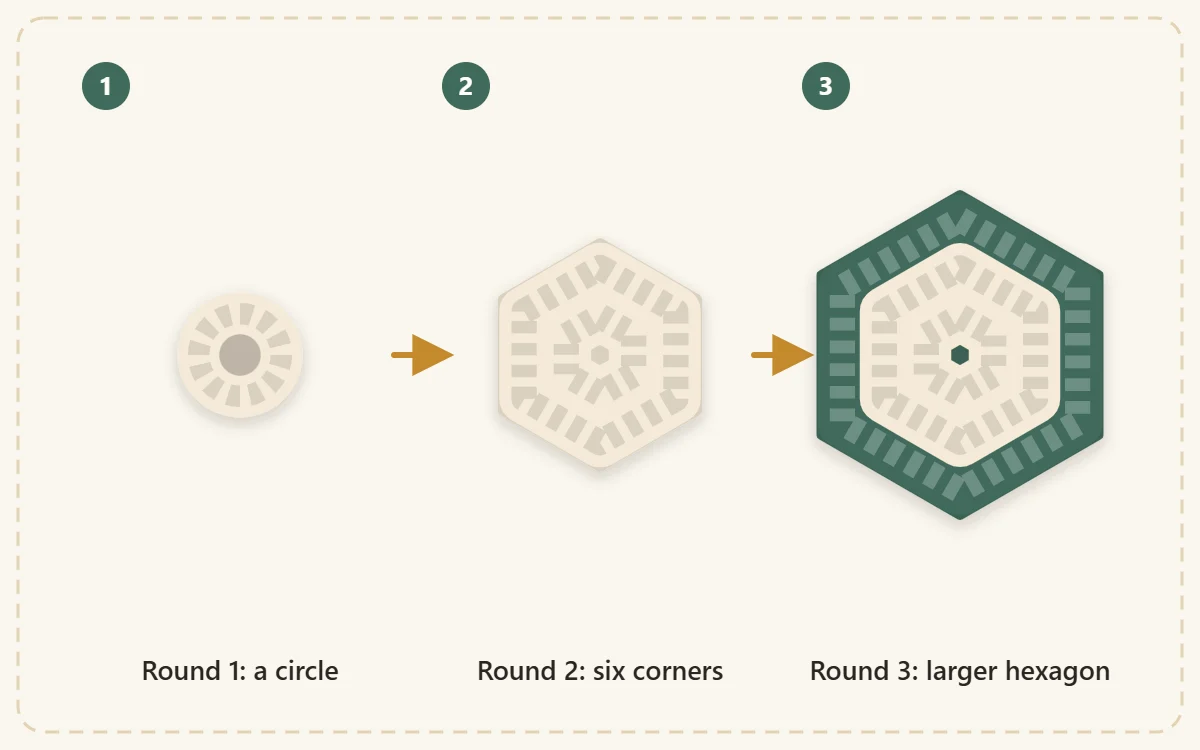
Round 2 is where a hexagon either comes out even or does not. The twelve stitches of round 1 are used in strict alternation: a corner in one, nothing in the next. Six stitches hold a corner and six are skipped, so the corners land exactly two stitches apart all the way around.
Each corner is four double crochets split by a chain 2. The first two belong to the side before the corner and the last two to the side after it, which is why each side of round 2 has four stitches: two from the corner at one end and two from the corner at the other.
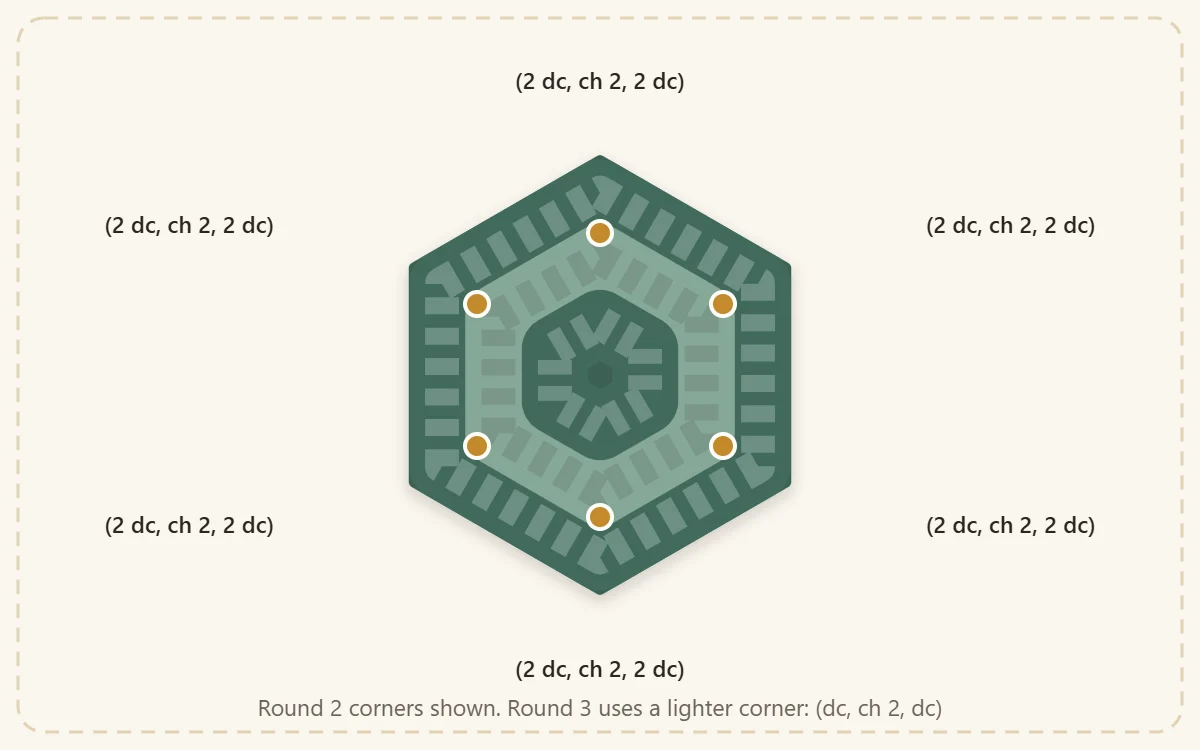
The round begins partway through a corner. The chain 3 is the first double crochet of that corner, so only one more double crochet goes in before the chain 2. At the end of the round, the last stitch of round 1 is a skipped one, and you join straight into the top of the chain 3.
Counting the Sides in Round 3
In round 3 every double crochet gets one double crochet, and every corner space gets a lighter corner of (dc, ch 2, dc). Each side gains two stitches, one at each end, and goes from 4 to 6. To check your work, count from one chain-2 space to the next: you should find six double crochets every time.
The side that contains the join is the easiest to get wrong. It is made of the second stitch of the last corner, the final two double crochets of the round, the chain 3, the double crochet after it and the first stitch of the next corner. That still adds up to six.
Watch out
Do not repeat the round 2 corner in round 3. A second round of (2 dc, ch 2, 2 dc) corners would give 8 dc per side and 48 dc in total, which is more edge than a flat piece of this size needs, and the hexagon would ripple. The lighter corner keeps the total at 36, the same count a flat double crochet circle has in its third round.
That lighter corner is also the one to use if you want a bigger hexagon. Any round added after round 3 should have (dc, ch 2, dc) in each corner space and a double crochet in every stitch, so each side gains two stitches per round: 8 dc per side and 48 in total for a fourth round. The reasoning is the same as for circles, set out in how to keep crochet coasters flat.
Adding a Single Crochet Border
A round of single crochet tidies the edge and is the natural place for a second color.
- Border: Join the border yarn with a sl st in any ch-2 space. Ch 1 (does not count as a stitch). *3 sc in the ch-2 space, sc in next 6 dc; repeat from * 5 more times. Join with a sl st in the first sc. (54 sc; 9 on each side)
For other options, see the borders in crochet coaster edging.
Joining Hexagons Into a Larger Mat
Because every side has the same number of stitches, hexagons line up stitch for stitch. Seven of them make a round mat: one in the middle and six around it.
- Make seven hexagons that match in size. Block them first so the sides are the same length.
- Hold two hexagons with right sides together and line up one side of each.
- With a yarn needle and matching yarn, whipstitch through the back loops only, from one corner to the next.
- Sew the six outer hexagons to the center one, then close the six short seams between neighbors. That is twelve seams in all.
Treat the joined piece as a larger table mat for cups, glasses or a plant pot. A single layer of crochet is not a tested barrier against heat, so do not assume it is suitable under hot cookware.
Finishing
Weave in the tails on the wrong side, keeping them out of the corner spaces, where they would show. Then pin out all six points when you block, so the sides dry straight and the corners stay crisp.
For a fall table, the same round start becomes something more playful in the pumpkin crochet coaster.
Frequently asked questions
How many stitches are on each side of the hexagon?
Each side has 4 double crochets after round 2 and 8 after round 3, counted from one chain-2 corner space to the next. The optional border has 11 single crochets per side.
Why is my hexagon coming out with uneven sides?
The corners in round 2 are probably not evenly spaced. Put a corner in every other stitch of round 1 and skip the stitch between, so six stitches hold corners and six are skipped.
How many hexagons do I need for a round mat?
Seven: one in the center and six around it. Make them all with the same yarn and hook and block them before sewing so the sides match.